I know many of you, particularly those who live on their own may be finding the prospect of self isolation daunting, and as this pandemic escalates, more of us will be indoors.
It is particularly nice when you email me about a post which has inspired you, so I know there are some of you who would like to paint with me and although you may all be at different skill levels, I think I will devise some painting which we can all enjoy.
I walked around my 'local' arboretum this afternoon, in the drizzle, thinking that this could be the last time I get the chance to do so for a while, Maggie got soaked and kept pulling me towards the exit, and I finally gave way when the water began pouring off my hat brim as I bent forward.
Passing through the plant shop on my way out some anemones and cowslips caught my eye.
These are what I bought, I intend to inspire you to get those paints out and paint along with me over the coming days and probably weeks. We will do some small little warm up exercises as well as some complete paintings.
I'm also going to get you to really look at things (I know, that sounds odd) but I will include photos to help and I hope you will join me.
You may like to keep a painting/sketch journal over this time, or a portfolio of your work so you can see your progress. (this is a posh 'arty' term for a folder or carrier bag with your paintings in it)
So lets paint together.
Stay safe and thank you to Agnes in France who sent me 'safe kisses' what a nice thought :)
Fiona
Today we have some lovely sunshine (although its pretty cold) and the little lambs are outdoors basking in sunshine.
This morning on my walk with Maggie we passed some adorable lambs and as I am teaching a workshop in two weeks time I thought a little painting time in the sunshine would be perfect, so this is my watercolour doodle from this morning.
The paper is actually white but it seems to appear more blue in the photo.
I feel as if spring is just around the corner!
We had such a lovely day in Marlborough painting a winter scene.
Everyone had used acrylics before, but some in the group were very nervous about the day, and in the end, they needn't have been because their results were really good.
Our first project was an allotment in snow, we all had the same photographic reference and blank canvases. When I began by saying that we wouldn't be drawing any pencil outlines to begin with, I could almost feel the sense of dread in the room. Its a daunting prospect for many people, the idea of beginning to paint with no guide lines of any sort, but instead of finding this daunting, we turned it on its head and thought about it as freeing, no lines to stick to, everything is movable, adjustable, and any changes simply implemented.
This is my painting at the midway stage. (sorry I forgot to take pictures sooner, I just got carried away)
This is where I got to when we finished for lunch. I may add a little more in the foreground, but I do rather like the free loose result so far, so I wont add too much.
If I do, I will of course post the final painting.
The group followed my suggestions when we painted together, however, I did say that after lunch they could use their own artistic twist on the day and do what ever they wanted.
I do think its important that participants on my workshops use what ever techniques of mine they chose to, but also have the freedom to add their own.
These were the results of their allotment paintings. They were all quite different and had lots of mood and atmosphere.
The group were so delighted with their second paintings that I am sure they wont mind my showing you. These were the ones they did using the second photo.
Thank you to all of you that joined me for this very enjoyable day, and I know some of you have already booked on the next workshop, so I'll see you then!
I walk past this open barn so often and have always been attracted to the light shining between the wooden planks and the pattern it creates. I am also attracted by the little cart which has been there as long as I have been walking here.
I have stopped so many times to look at it, thinking I would paint it one day. At this time of year it is clear to see, but once the leaves begin to appear on the trees, this view gradually becomes more obscured, so as each year has passed my opportunity slipped by, but not this year.
We have had so much rain this year that when the sun does come out, I feel a flurry of excitement and the need to enjoy it, appreciate it and use it. Washing can blow on the line, blankets can be aired, and the light is perfect for painting.
Maggie used to get a little confused when I gathered up her various bedding and hooked it onto chairs or shrubs in the garden to get a good airing. There would always be one mat left on the ground in the sun for her to lie on, she sun bakes, even in February.
I rushed to take advantage of the sunshine and this is my finished painting, (10 x 12 inches) it's an unusual subject for me, but it turned out as I had hoped and I now have my eye on some tractors....
I began by sketching my composition using a dilute dark. Adding lots of water to acrylic at this stage, to dilute it for the sketch, means it can easily be adjusted, wiped off if need be.
I paint at an easel standing a couple of feet away from the board and use a long handled brush. This ensures that I look more at the subject and am more discerning about where to place my initial marks.
This scene has very subtle colours, there are no real brights, but I do see blues and ochres, so I block those in. Already after a very short time, my basic composition is there.
Once at this stage, its all about building up the painting.
If I am outside and have limited time, or the weather changes, the painting will be less detailed and often, I feel, more interesting that one painted entirely in the studio.
The challenge when working indoors and using photos exclusively (as opposed to beginning a painting outside and adding details later in the studio) is that there is a tendency to look for the tiny details within a picture before the basics are there.
I like my subject to emerge from the canvas. This is my personal way of working, I know its not everyones, so if it doesn't work for you, then perhaps its not right for you.
Thats one of the fascinating things about painting, its more about the way we see things, rather than the way we put the paint on the canvas.
I realise you are probably now thinking 'there is no such thing as Easter mice' and you would be correct, however, this year, in my house.... there will be!
With Easter just around the corner, I decided to make some little family gifts, using scraps of fabric, some stuffing and whatever I could find in my 'bits and bobs' box. I do love fabrics, and tend to keep pieces from clothing and all the off-cuts from various projects over the years.
Sitting in the studio, with the scent of daffodils and being surrounded with beautiful colours inspired these little mice.
Do you remember learning 'blanket stitch' at school? I think other than basic 'running stitch' and 'cross stitch' its the first fancy stitch you learn, often on pastel coloured binca fabric ( I think that's what it was called) traditionally used to edge blankets, blanket stitch is perfect for attaching pieces of felt together or any felt like non fraying fabric.
French knots for the eyes, another easy little stitch, and some hours later....
These little mice stand 5" tall, they are weighted at the bottom ( I know, that does sound rather clever) but I used some 'out of date' split peas which have been lurking in the back of a kitchen cupboard with a 'use by' date of 2017 on them. (never let it be said that I waste anything)
I used to enjoy making lentil and split pea soup, using stock from a ham joint, but sadly, those days are no more, so the split peas have been put to good use.
This is probably a better view of them. They are very easy to make, and I think they will be loved when they 'appear' in their new home at Easter. I may even make a couple more before then, I have my eye on some patterned fabric which I am itching to use.
I might have them as the 'treasure' at the end of a hunt.
You know when you see something, and you cant un-see it? That's what happened.
Its like those magic pictures, look at them a certain way and you see something different, and once seen, you then see it all the time.
My painting remained on the easel and each time I glanced across, I saw it.
I had a sneaky look, and it was still there.
This morning when I returned from my walk I just had to do it, opened my palette and altered the painting.
Below are the two photos, the top one is the before (the same as my last post) and the one below is the altered one.
I wonder if you spot the change straight away? Do tell me if you do!
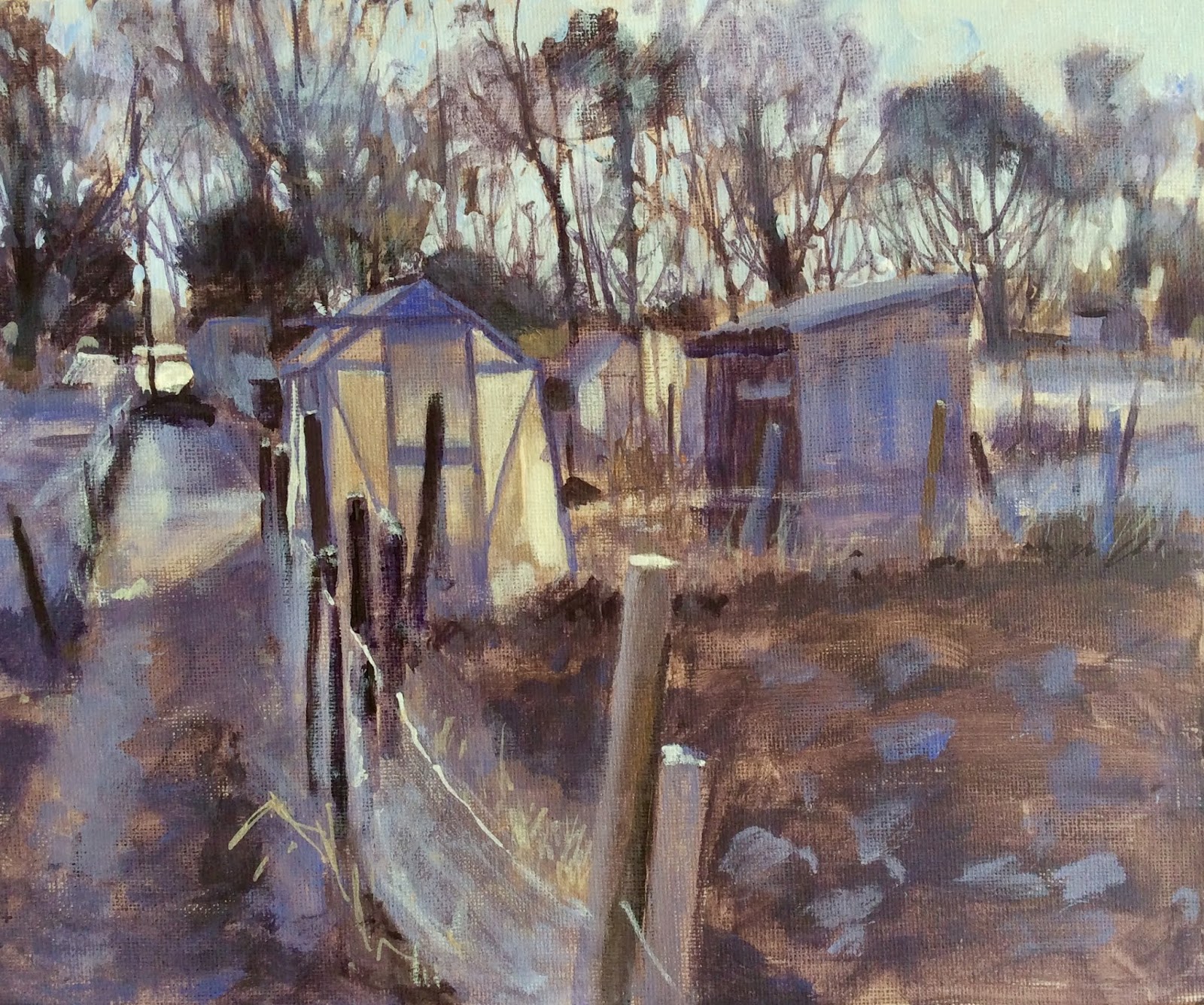
I love to see low winter sunlight glowing through greenhouses. On chilly mornings, it is as if they are all made of frosted glass as they glow like little lanterns twinkling in the morning sun. Frost laden wires guide the pathways in between the various plots drawing me this way and that.
The occasional excited bird songs are silenced as I approach the hedges adjoining the fields, but if I stand quietly their chirping begins once again and I no longer feel like a threat to them.
This is my latest painting and for those of you who would like to see how it built up, do read on.
There are many ways to use acrylics, this is the process that works for me, if you have a totally different approach, that's great, please don't feel you need to change the way you paint, there is no right or wrong way.
I always stand to paint at my easel when I work on a canvas, and I walk backwards and forwards in order to judge the proportions.
Stepping back and looking again can really help to see any areas that may not look right.
This first stage plots out where the main objects sit. The paint is very dilute, so much so you can see where it has run down the canvas.
Once the basic shapes are blocked in, I add the dark background areas and the dark area of soil in the foreground.
I use directional brush strokes so that if any gaps are left at a later stage, these strokes will all help to suggest the surface texture or direction of the ground surface.
Then I begin to add colour. I saw a lot of mauve's and cool colours in the mid tone sections.
Once I get to this stage, everything is where I want it and my tonal areas are all there, I now need to build up the painting, adding some details and of course the light.
This was a lovely composition for me, I walked down that path right to the end (where there is a clutter of various chairs and make shift tables abandoned since last Summer) there are so many sections I want to paint, this is one I will no doubt tackle again, when the colours all change and the picture is totally different.